Autonomous AP & 3-Way Match Pipeline
LedgerFlow: Autonomous invoice extraction and three-way purchase order matching.
Extracts multi-page vendor PDFs with deterministic math checks, reconciles lines against purchase orders and receipts, and posts clean vouchers to the ERP.
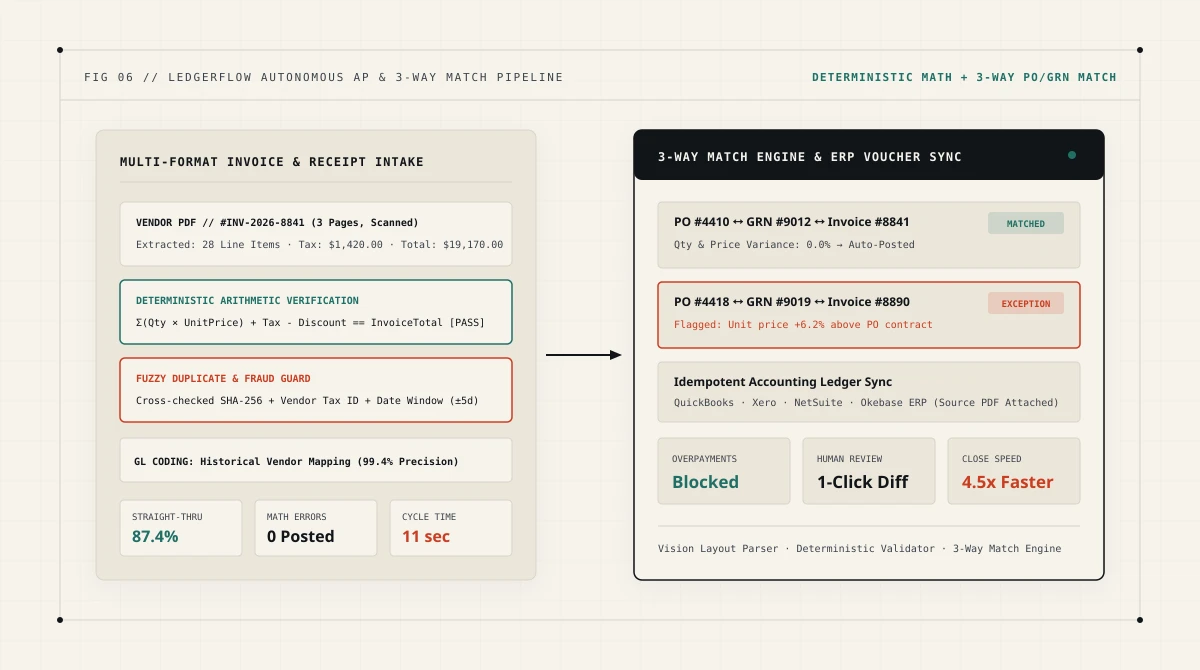
System Architecture Schematic
The Business Pain Point & Operational Requirements
Why off-the-shelf software breaks under this workflow.
Finance and operations teams processing hundreds or thousands of monthly vendor invoices spend 15+ hours a week keying PDF line items into QuickBooks, Xero, NetSuite, or their ERP, hunting down warehouse receiving slips in email threads, and fixing SKU unit-of-measure mismatches by hand.
According to Ardent Partners Accounts Payable benchmarks, manual processing costs $12 to $30 per invoice, takes an average of 10.9 days to approve, and exposes the business to duplicate billings, unnoticed supplier price creep, and missed early-payment discounts.
What the operation required
- 01Ingest multi-page PDFs, scanned delivery tickets, and international invoices automatically from shared AP inboxes, supplier portals, and mobile uploads.
- 02Verify every extracted line item against deterministic mathematical rules (`Qty × Unit Price + Tax - Discount == Total`) before any data touches the general ledger.
- 03Automatically reconcile invoices against open Purchase Orders (PO) and warehouse Goods Received Notes (GRN), routing only genuine price or quantity variances to human reviewers.
- 04Post approved, GL-coded vouchers idempotently into the accounting ledger with the source PDF permanently attached.
In-Depth Features & Functional Modules
What the system does in production
Multi-channel document intake & layout-aware extraction
Monitors dedicated AP email inboxes, EDI feeds, and mobile warehouse uploads—extracting complex multi-page tables, tax breakdowns, freight charges, and vendor metadata regardless of template layout.
Deterministic math, tax & fuzzy duplicate guard
Cross-checks line-item arithmetic in code and screens every incoming bill against historical invoices using SHA-256 file hashes plus fuzzy matching on `(Vendor Tax ID + Invoice Number + Amount + ±5-day window)`.
Automated 3-Way Match (PO ↔ GRN ↔ Invoice)
Links vendor line descriptions to internal master SKUs, converts packaging units (such as cases of 24 to individual units), and verifies that billed quantities and prices fall within contract tolerance thresholds.
Side-by-side exception workbench & ERP sync
Auto-posts clean invoices straight through to QuickBooks, Xero, NetSuite, or Okebase, while presenting flagged variances in a split-screen UI that highlights the exact bounding box on the source PDF.
Technical Architecture
Four-stage production pipeline
Document Ingestion & Pre-Processing
IMAP/Webhook listeners ingest PDFs and scans, deskew pages, and compute cryptographic hashes for instant duplicate rejection.
Vision-LLM Extraction & Math Verifier
Layout-aware multimodal extraction outputs strict JSON schemas validated by a deterministic Python arithmetic and tax-rate engine.
3-Way Match & GL Coding Engine
Matches invoice lines against ERP Purchase Orders and warehouse GRNs using hybrid vector + fuzzy SKU resolution and historical GL account mapping.
Exception Workbench & Ledger Connector
Routes out-of-tolerance bills to human approvers and writes approved vouchers idempotently to the ERP/accounting API.
Engineering Complexity & Stack
Hard technical problems solved under the hood
Zero tolerance for hallucinated numbers in financial ledgers
Never trusted raw model output for accounting totals: every invoice must pass a deterministic cross-footing equation (`sum(line_items) + tax + shipping - discount == header_total`); any 1-cent discrepancy triggers targeted re-OCR and highlights the exact cell.
Cross-unit SKU reconciliation across messy vendor catalogs
Built a self-improving vendor alias and unit-of-measure conversion table so when a supplier bills "2 Pallets (48 ct)" against a PO written for "96 Units", the 3-way match engine reconciles the math automatically.
Catching subtle double-billing across channels
Combined exact document hashing with fuzzy composite keys to block duplicate payment when a vendor emails a PDF invoice and later mails or uploads a re-scanned copy of the same bill.
Architectural Takeaways
Principles we carry into every custom deployment
Principle 01
In financial document automation, AI should do the reading, but deterministic code must do the math and enforce tolerance gates.
Principle 02
Designing the 12% exception review screen with bounding-box PDF highlights is what wins daily trust from controllers and bookkeepers.
Explore More Case Studies
Other systems we have architected
Okebase
Multi-Entity ERP & Operations LedgerUnifies inventory, purchasing, approvals, and consolidated accounting across subsidiaries with database-enforced tenant isolation and sub-50ms ledger queries.
VoxFlow
Autonomous Voice & Lead Dispatch EngineAnswers every inbound call on the first ring, dials new web leads within 45 seconds, locks live calendar slots, and syncs the CRM.
AdVantage
Omnichannel AI Sales & Campaign EngineUnifies WhatsApp, Instagram, and Messenger with a catalog-grounded AI sales representative and closed-loop Meta campaign automation.
Opsera
Slack-Native Company Operations OSRuns daily standups, leave approvals, RBAC task tracking, and AI thread-to-task structuring in Slack, synced with an executive web cockpit.
SyncDaily
Personalized AI Intelligence PlatformIngests and deduplicates global AI research, model releases, and market moves into tailored impact briefings for leaders, engineers, and students.
RunwayIQ
13-Week Treasury, BI & Demand ForecasterConsolidates accounting, commerce, and warehouse data to project rolling 13-week cash runway, flag inventory stockouts early, and simulate financial scenarios.
VaultRAG
Permission-Scoped Knowledge & Data EngineDeduplicates messy CRM records and answers operational questions across internal SOPs, contracts, and databases with role-level access controls and exact page citations.
Dealing with a similar operational bottleneck?
We architect, customize, and deploy systems like this tailored to your workflow and contract structure—or start with a free 2–4 page written systems review.